Land Management · Insights
Forestry Mulching vs Traditional Land Clearing in the NC Piedmont
Almost every land clearing call we take in the NC Piedmont starts the same way: the owner has too much brush, too many small trees or too many years of neglect, and they want it gone. What they usually do not know is that there are two very different ways to get there, and the wrong pick can cost thousands or leave the property worse off.
This is a plain-English comparison of forestry mulching and traditional land clearing based on what we actually run day to day across Guilford, Forsyth, Davidson, Alamance and surrounding counties. Use it to decide which method fits your property, your timeline and your long-term plans.
What Each Method Actually Is
Forestry mulching is a one-machine, one-pass process. A tracked carrier runs a rotary drum with steel teeth that grinds standing brush, saplings and small trees in place, leaving a shredded mulch layer on the ground. Nothing is hauled off, nothing is burned, and root systems typically stay intact.
Traditional land clearing is a multi-machine process: a dozer or excavator pushes and piles vegetation, stumps get pulled or ground, debris is hauled off or burned, and the ground is stripped closer to bare dirt. It is more aggressive, more disruptive and, when done right, produces a truly blank slate ready for grading or construction.
When Forestry Mulching Is the Right Call
For most residential and rural residential jobs in the Piedmont, forestry mulching is the smarter first move. It handles the underbrush, greenbrier, small hardwoods and pine saplings that make property unusable, without stripping the canopy you actually want to keep.
It is especially strong on wooded acreage where the goal is reclaimed usable land, walking trails, view corridors or fire-break maintenance. Because there is no hauling and no burning, permitting is simpler and the neighbors barely notice we were there.
- Reclaiming overgrown back acreage without losing mature trees
- Cutting trails and view lines through wooded lots
- Ongoing pasture edge and fence line control
- Wildlife and hunting tract maintenance
- Sites where soil disturbance would trigger erosion problems
When Traditional Land Clearing Is the Right Call
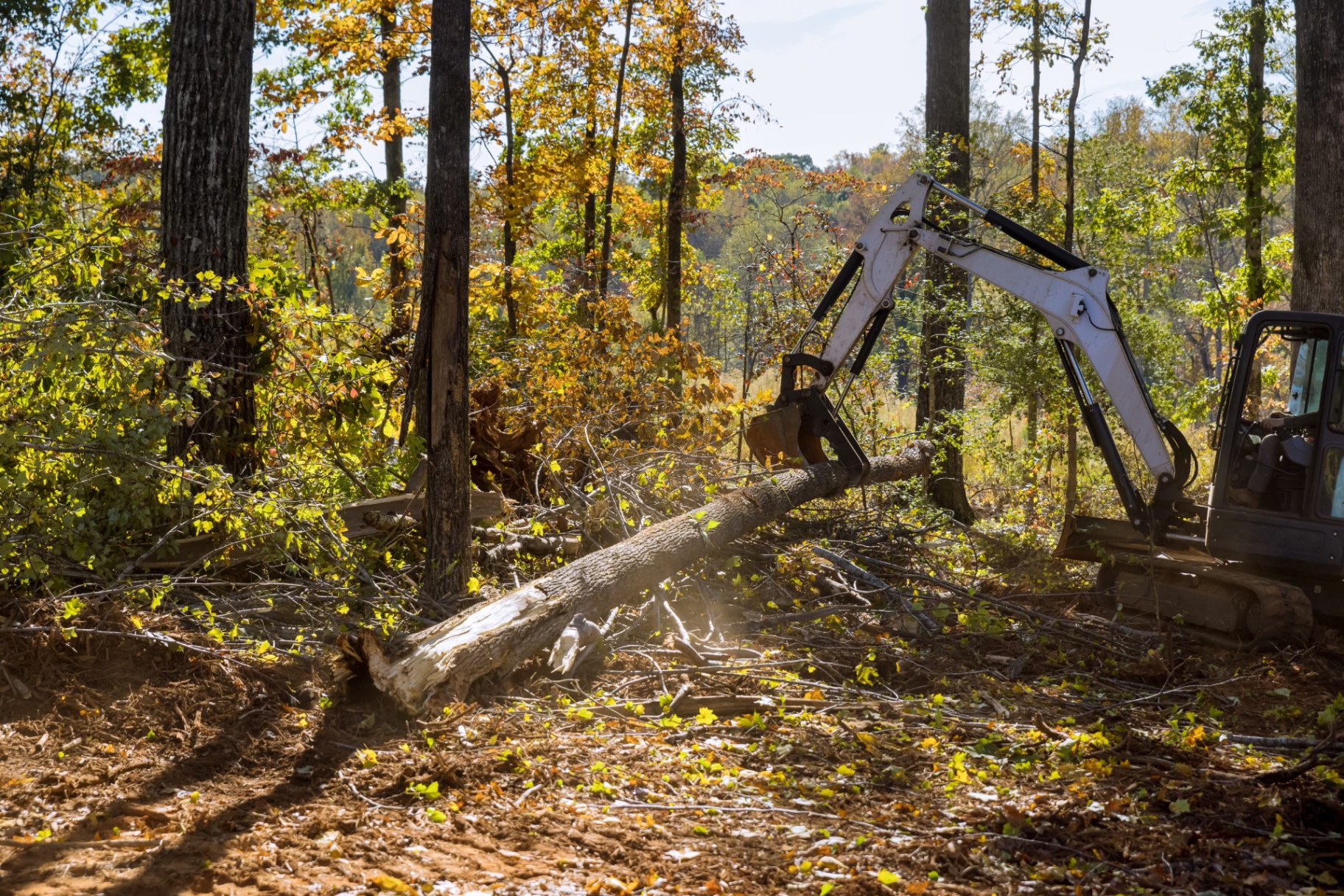
Traditional clearing wins whenever the ground under the vegetation has to change. If you are prepping a house pad, a shop pad, a driveway cut, a septic field or a pond site, you need stumps out, roots pulled and grade re-shaped. Mulching alone cannot do that.
It is also the right choice on any residential project where the site plan calls for bare, gradable dirt, whether that is a new home pad, a driveway cut or a re-worked backyard. On heavy Piedmont red clay, that grading step is where drainage either gets solved or gets baked in for the next twenty years.
Cost, Timeline and What Drives the Number
Mulching pricing in the Piedmont typically runs by the hour or by the acre and depends on stem density, tree diameter and terrain. Light underbrush on flat ground moves fast; dense 6 to 8 inch hardwoods on a slope do not. Expect a wide range and get an on-site walk before trusting any per-acre number.
Traditional clearing carries additional costs: haul-off or burn permitting, stump removal, and often follow-on grading. It is usually the more expensive line item on the estimate, but it delivers a finished pad, not just cleared vegetation. Comparing the two on price alone is the wrong lens; compare them on what the ground has to look like when we leave.
Soil Health, Erosion and Drainage on Piedmont Clay
The NC Piedmont sits on heavy red clay that compacts, sheds water and erodes fast once it is exposed. Forestry mulching leaves a protective organic layer on the surface and keeps root structure in place, which is a big win for erosion control on any slope.
Traditional clearing exposes bare soil. Done well, it is paired with immediate stabilization: silt fencing, temporary seeding, swales or check dams. Done poorly, the first heavy storm turns the site into a rutted, gullied mess and the drainage problem becomes yours to fix later. Any reputable crew will price stabilization into the job, not as an upsell after the fact.
Common Mistakes Property Owners Make
The most expensive mistake is picking a method based only on the estimate. A mulching quote will almost always look cheaper than a full clearing quote because it is doing less. If the plan is a new build, choosing mulching to save money now usually means paying twice when a real clearing and grading crew has to come back.
The second mistake is skipping the on-site walk. Satellite estimates miss slope, wet spots, buried debris and stem density. Every KNS LandWorx estimate is walked in person for a reason: the ground tells us what the map cannot.
A Simple Framework to Decide
Ask two questions. First, does the ground under the vegetation need to change? If yes (pad, driveway, drainage regrade, foundation), you need traditional clearing, likely paired with grading. If no, mulching is usually enough.
Second, do you want to keep the mature trees? If yes, mulching. If the goal is a clean, gradable site, traditional. Anything in between is a hybrid, and hybrids are exactly what we scope on the walk-through.
Frequently Asked Questions
Can I combine forestry mulching and traditional clearing on the same property?
Yes, and it is often the best answer. We mulch back acreage and trails, then run traditional clearing on the specific footprint that needs a pad, driveway or drainage fix.
Does forestry mulching kill invasive species?
It knocks them back hard but does not eliminate roots. Serious invasive control usually pairs mulching with a follow-up treatment plan.
How long before I can drive or build on a mulched area?
You can walk and mow it immediately. For building or driving, you still need stump removal and grading, because mulch is not a load-bearing surface.
Ready to talk through your project?
We walk every property in person before quoting. Get a straight answer from a crew that runs this work every week.
Keep Reading
Land Grading and Yard Leveling Cost in the NC Piedmont
Grading quotes swing wildly because the word means five different jobs. Here is what land grading and yard leveling actually cost, and how to compare bids line by line.
Read guide ExcavationStump Grinding and Stump Removal Cost in the NC Piedmont
Per stump, per hour or per acre? Here is how stump grinding and full root removal are priced in the NC Piedmont, and what makes one quote double another.
Read guide Land ManagementPasture Clearing and Reclamation Cost in North Carolina and Southern Virginia
Grown-up pasture comes back in stages, not one pass. Here is the full reclamation sequence and what each step costs, from first mulching pass to first grazing season.
Read guideGet a Free Insights follow-up (Land Management) Quote
Step 1 of 2: tell us how to reach you and what service you need. We'll follow up with honest guidance and a written quote.
Ready to reclaim your property?
Free, no-pressure quotes across the NC Piedmont Triad. Call today.