
Land Management · Insights
Pasture Clearing and Reclamation Cost in North Carolina and Southern Virginia
Pasture clearing cost depends far less on acreage than on how long the ground has been out of rotation. Pasture that sat idle three years is a mowing problem. Pasture that sat idle fifteen years is a clearing project with drainage, fence line and seeding work attached. In North Carolina and Southern Virginia in 2026, full pasture reclamation generally runs $2,000 to $6,500 per acre depending on which of those two situations you are actually in.
This guide walks the whole reclamation sequence in the order it has to happen, with cost ranges at each step: assessment, the first clearing pass, stumps and rock, fence lines, grading and drainage repair, soil and seeding, and the first-year maintenance schedule that keeps you from paying for all of it twice. It is written for farm owners, rural residential owners and hunting tract owners across the Piedmont, the Dan River counties and Carroll, Patrick and Henry County, Virginia.
Start by Grading the Ground, Not by Getting Bids
Pasture reclamation cost is set at the assessment stage, because what you find determines the scope. Before you call anyone, walk the field and record four things: the largest woody stems present, whether old fence wire and posts are still standing or laid down in the grass, where water sits after rain, and whether the surface still has a grass seed bank underneath the brush.
Those four observations sort your field into one of three tiers. Tier one is recently idle ground with grass still present under two to three years of briar and seedlings. Tier two is ground with a real understory and stems up to six inches, often with the old fence line swallowed. Tier three is ground that has gone to young woods, with a closed canopy, no remaining grass, and drainage patterns that have changed since the field was last mowed.
Getting the tier right matters because the cheap version of the work only exists in tier one. Every bid you collect should reference which tier the contractor thinks you are in, and if it does not, you are comparing prices for different projects. We put the tier assessment in writing on every pasture walk-through so the owner and the crew are pricing the same field.
- Tier one, idle two to three years, grass seed bank intact: mowing and maintenance pricing
- Tier two, real understory up to six inch stems: clearing plus fence and seeding work
- Tier three, gone to young woods: full reclamation with grading, stumps and reseeding
- Old wire, posts and dumped debris move any tier up in price
Step One: The First Clearing Pass
The first pass is the single largest line item in pasture reclamation, and the right machine depends entirely on stem size. Under about two inches with grass still underneath, a heavy rotary cutter is the correct tool and costs roughly $175 to $325 per acre for a first knockdown, more if the material is thick enough to require two directions of travel.
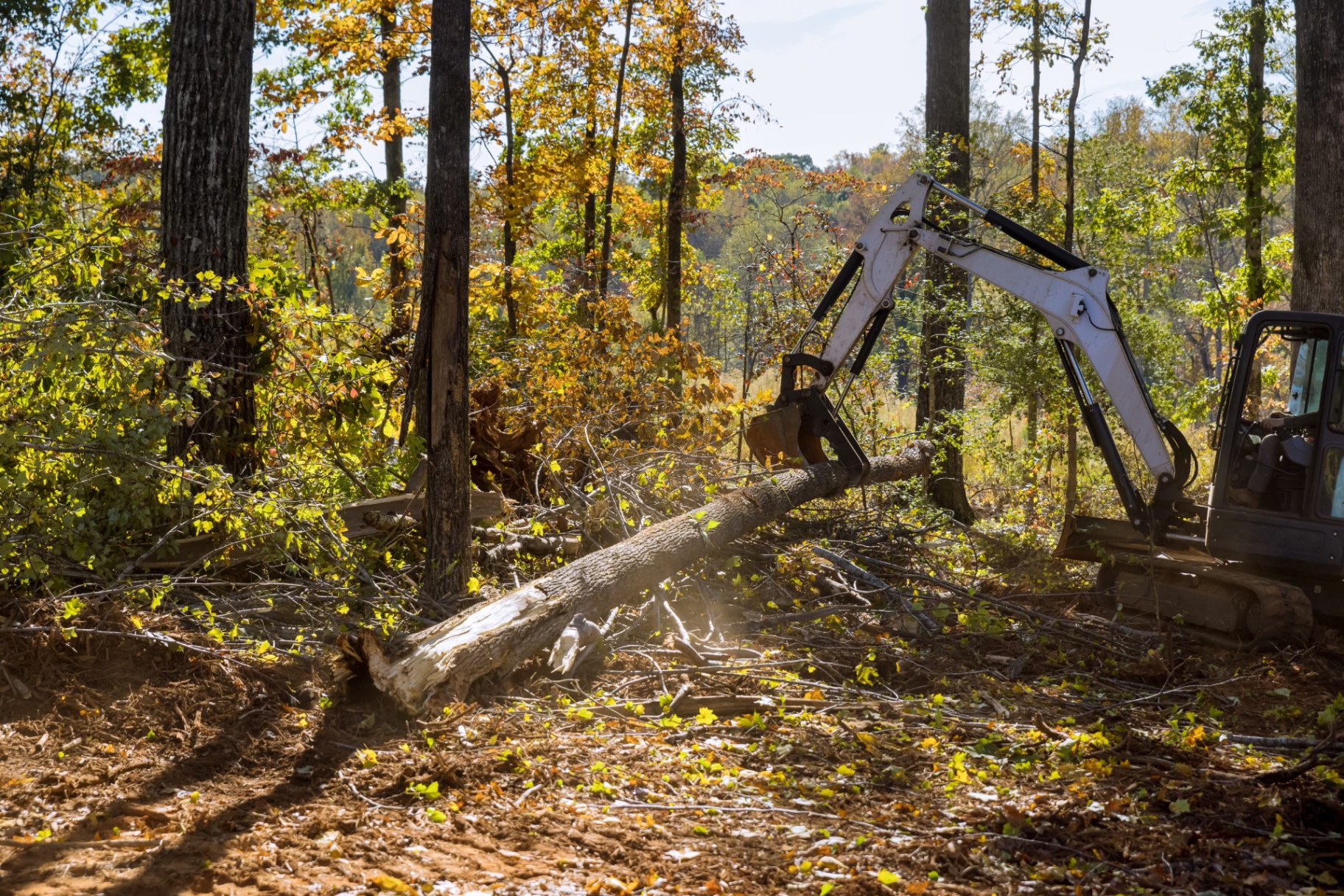
Once real woody stems are present, a rotary cutter stops being safe or effective, and the work moves to a mulching head. Mulching an overgrown pasture typically runs $1,400 to $3,400 per acre depending on stem density, and heavier tier three ground with a closed canopy runs $3,400 to $5,500 per acre. The advantage over conventional clearing is that the material stays on the field as a mat that protects soil and breaks down into it, which matters when you are trying to rebuild ground rather than strip it.
For pasture specifically, we usually recommend a rough mat rather than a fine one across the open acreage, then a finer finish only in the areas that will be seeded first. Grass needs seed-to-soil contact, so a thick mat delays establishment. Getting that balance right is why we quote bush hogging and pasture maintenance and mulching as one plan instead of two disconnected line items.
- Rotary cutting first knockdown, light material: $175 to $325 per acre
- Mulching overgrown pasture, two to six inch stems: $1,400 to $3,400 per acre
- Tier three closed canopy: $3,400 to $5,500 per acre
- Rough mat across the field, fine finish only in first-seed areas
Step Two: Stumps, Root Balls and Rock
Stumps are what turn a cleared field into a usable field, because equipment cannot safely cross a pasture full of hidden root flares. Mulching grinds most small stems to or slightly below grade, which handles the majority of a tier two field. What remains is the larger material: mature hardwood, old volunteer cedar, and anything that grew inside a fence line.
Grinding those remaining stumps is priced per stump by diameter, and full excavator removal of a root ball is quoted on the walk-through. For pasture work the deciding question is what will cross that spot. Under a hay field where a mower and rake will run, stumps need to be ground below grade so nothing catches a blade. Under a future barn pad, lane, pond dam or fence post line, the root ball needs to come out entirely, because decaying roots will settle and take your improvement down with them. Our stump grinding and tree removal pricing separates those two outcomes so you are not buying full removal across a whole field you only intend to mow.
Rock is the wildcard in this region. Piedmont fields regularly hide fieldstone that was once picked and piled along a fence line that has since disappeared into brush. Budget a half day to a day of machine time for rock and legacy debris on any tier two or three field, and expect to find at least one old wire roll, one dump pile and one buried post line. Finding those on the walk-through is cheap. Finding them with a mower deck is not.
- Mow-only ground: grind stumps below grade so implements clear
- Pads, lanes, dams and fence lines: remove root balls completely
- Budget a half to full machine day for rock, wire and dump piles
- Mark every found obstacle on a map before the mowing era begins
Step Three: Fence Lines and Boundaries
Fence line clearing is where reclamation projects quietly go over budget, because a fence line is linear work priced by the foot of time rather than by the acre. A grown-in fence row with mature volunteer trees, embedded old wire and a bank on one side can take as long as several open acres.
Do the fence line work before you seed, never after. The equipment corridor along a boundary is the most disturbed ground on the property, and running it after establishment means reseeding it twice. It is also the right time to decide whether the old fence stays or goes, because pulling posts and wire out is far cheaper while a machine is already positioned there than as a separate mobilization later.
One practical note for both Carolina and Virginia owners: clear to your line, not past it. We survey pins or work off owner-flagged boundaries before the first pass, especially where a neighbor's timber meets an old field edge. Cutting a neighbor's trees is an expensive mistake that no discount on the clearing offsets.
- Fence line clearing is linear work, priced by time not acreage
- Do boundary work before seeding to avoid reseeding the corridor
- Pull old posts and wire during the same mobilization
- Flag or survey property pins before the first pass
Step Four: Grading and Drainage Repair
Drainage is the step most owners skip and the one that decides whether the pasture holds up. Fields that sat idle for a decade almost always have three problems: old surface drains and swales that filled in with silt and brush, wheel ruts and gullies from the last era of use, and a low spot or two that now holds water long enough to kill grass and rut under hoof traffic.
Fixing that is grading work, and it is cheapest right after clearing while the ground is bare and visible. Reshaping swales, filling ruts, smoothing a field to a mowable surface and daylighting a drain to an outfall typically runs $600 to $2,500 per acre depending on how much material has to move. Localized work, like one bad wet area and a couple hundred feet of swale, is often a one to two day job rather than an acreage price.
Wet ground under grazing is not a cosmetic issue. Hooves on saturated clay destroy soil structure, create mud lots and set back establishment by a full season. If the walk-through shows standing water or an active gully, do the grading and drainage work before seed goes down, and stabilize any disturbed slope so the first heavy rain does not move your new soil into the creek.
- Reopen filled swales and daylight drains to a real outfall
- Fill ruts and gullies before seeding, not after
- Typical range: $600 to $2,500 per acre depending on material moved
- Stabilize disturbed slopes immediately to protect new seed
Step Five: Soil, Seed and the Establishment Window
Seeding is the cheapest step and the one most sensitive to timing. In this region the reliable windows are late summer into early fall for cool season grasses like fescue and orchardgrass, and late spring for warm season mixes. Fall is generally the stronger window for reclaimed Piedmont pasture because there is less weed pressure and the ground still holds warmth.
Test the soil before you buy seed. Ground that grew brush for a decade is usually acidic and low on phosphorus, and lime takes months to change pH, so it should go out ahead of or with the seeding, not after. Your county extension office runs soil tests inexpensively, and the recommendation it returns is worth more than any general advice a contractor can give about fertility.
Mechanically, reclaimed ground seeds best with light surface preparation rather than full tillage. Disking a freshly cleared field brings up rock, buried wood and a decade of weed seed. Where the mulch mat is thin, drilling or broadcasting with a light drag is enough. Where the mat is heavy, rake it aside or grind it finer in the seeding zones first, because seed sitting on top of chips will not establish.
- Best windows: late summer to early fall, or late spring for warm season mixes
- Soil test first, then lime early because pH change is slow
- Prefer light surface prep over full tillage on reclaimed ground
- Seed needs soil contact, so thin or move heavy mulch mat in seeding zones
Step Six: The First Year of Maintenance
The first twelve months determine whether reclamation holds. Woody species that were cut, not killed, will sprout from the root system, and a reclaimed field left alone for a year can look almost untouched by the following summer. The fix is scheduled, not reactive.
A workable first-year plan is two mowing passes in the growing season to keep sprouts below the grass canopy, spot treatment of persistent stump sprouts and briar, and a light second seeding of any thin areas in the following fall. Two rotary passes per year on established pasture typically run $150 to $275 per acre per pass in this market, which is a small fraction of what a second reclamation would cost.
Grazing pressure should be introduced gradually. New stands need a full establishment season before they carry stock, and putting animals on thin grass in a wet spring undoes the grading work you just paid for. If you need the ground producing sooner, hay it the first season instead of grazing it.
- Two mowing passes in year one keeps woody sprouts from taking back over
- Spot treat stump sprouts and briar rather than re-clearing
- Rotary maintenance passes typically $150 to $275 per acre per pass
- Hay the first season if you cannot rest it from grazing
A Worked Example on Fifteen Acres
Take a fifteen acre field twenty miles from Rural Hall that has been idle about twelve years. On the walk it splits into nine acres of tier two ground with a two to six inch understory, four acres of tier three where cedar and sweetgum closed the canopy, and two acres still relatively open with grass surviving under briar. There is roughly 1,800 feet of grown-in fence line, one wet area near a filled swale, and a rock and wire pile hidden mid-field.
A realistic scope prices near $18,000 to $28,000 for mulching the tier two and three acreage, $500 to $900 for rotary cutting the two open acres, $2,500 to $5,000 for fence line clearing and old wire removal, $2,000 to $4,500 for grading the wet area and reopening the swale, $1,500 to $3,500 for the stumps that fall in future lanes and gate areas, plus seed, lime and one mobilization. Call the total $26,000 to $45,000 to take fifteen idle acres back to seeded, mowable pasture.
Phased, the same field is far easier to fund. Year one: clear the nine tier two acres, clear the fence line, fix the drainage, seed what you cleared. Year two: take the four heavy acres and stump the lanes. Year three: maintenance only. That sequence spreads the cost, gets grass growing on the majority of the field a year earlier, and means the expensive acreage is cleared into a property that already works instead of one that does not yet.
- Price each tier separately rather than as one blended per-acre number
- Fence lines and drainage are separate line items, not rounding errors
- Phase over two to three seasons to fund it without stalling progress
- Seed each phase as it is finished so nothing sits bare through a winter
Common Mistakes in Pasture Reclamation
The most common mistake is clearing more acreage than you can maintain. Reclamation is a one-time cost and maintenance is forever, so an owner who opens fifteen acres but only mows five ends up watching ten acres revert. Decide your maintainable acreage first and clear to that number.
The second is seeding before drainage. Grass planted on ground that holds water dies in the first wet spell, and the money spent on seed, lime and labor goes with it. Water first, grass second, every time.
The third is treating stumps as optional. A field that looks clean but hides root flares is a field that will break a mower deck and end a haying season. Grind what will be mowed and remove what will be built on or driven over.
The fourth is doing the work in the wrong order. Clearing, then fence lines, then grading, then seeding, then maintenance is the sequence, and every step done out of order costs money to redo. Clearing after seeding means reseeding. Grading after seeding means regrading and reseeding. If a bid puts these in a different order, ask why.
The fifth is skipping the soil test to save fifteen dollars, then spending several thousand on seed that will not thrive at the field's current pH. That is the worst return on any decision in this whole process.
- Clear only what you will maintain
- Fix drainage before seed goes down
- Grind or remove stumps according to what will cross that spot
- Keep the sequence: clear, fence, grade, seed, maintain
- Always soil test before buying seed and fertilizer
Putting the Pasture Reclamation Budget Together
Add the steps rather than looking for one per-acre number. For a typical tier two field, the stack is clearing at $1,400 to $3,400 per acre, drainage and grading at $600 to $2,500 per acre where needed, stumps priced by count and size, fence line clearing priced by the foot of work, seed and lime at a few hundred dollars per acre, and maintenance at $150 to $275 per acre per pass afterward.
One mobilization covers the visit, so bundling clearing, stumps, fence lines and grading into a single scheduled window is materially cheaper than four separate calls across a year. If a heavier clearing scope is involved, our land clearing and brush removal crews handle it on the same mobilization as the pasture work.
The right next step is a walk-through with the field tiers, obstacles and drainage marked, and a written scope broken into phases you can fund in the order that gets grass growing soonest. That document is what turns a vague acreage number into a project you can actually run.
- Build the budget by step, not by a single blended per-acre figure
- Bundle clearing, stumps, fence lines and grading into one mobilization
- Ask for a phased written scope tied to seeding windows
- Reserve maintenance dollars in the same plan as the reclamation
Frequently Asked Questions
How much does it cost to clear an overgrown pasture?
Full reclamation generally runs $2,000 to $6,500 per acre in North Carolina and Southern Virginia. Fields idle two or three years with grass still underneath can be handled with rotary cutting at $175 to $325 per acre, while ground that has gone to young woods runs $3,400 to $5,500 per acre just for the clearing pass.
What is the difference between bush hogging and pasture reclamation?
Bush hogging is maintenance of ground that is already open, using a rotary cutter on light material. Reclamation is the project that takes woody, overgrown ground back to open pasture, and it usually includes mulching, stumps, fence lines, drainage and seeding.
How long does it take to get an overgrown field back to grazeable pasture?
Plan on one full growing season after clearing before you put stock on it. Clearing, grading and seeding can happen in a few weeks, but grass needs an establishment season, and most owners hay the first year instead of grazing it.
Should I clear the whole field at once or in phases?
Phase it unless budget is not a constraint. Clearing and seeding the easier acreage first gets grass producing a year sooner, spreads cost across seasons, and prevents you from opening more ground than you can maintain.
Do I need to remove stumps to have pasture?
Stumps in ground you will only mow should be ground below grade so implements clear them safely. Stumps under a future lane, gate, barn pad, pond dam or fence post line need to be removed entirely, because decaying roots settle and take the improvement with them.
When is the best time to seed a reclaimed pasture in North Carolina?
Late summer into early fall is the strongest window for cool season grasses in this region, with late spring as the alternative for warm season mixes. Lime should go out ahead of or with seeding because pH takes months to move.
Can you clear pasture without disturbing the soil?
Mulching is the lowest disturbance option because the material is converted in place and left as a protective mat. Full grubbing and hauling disturbs far more soil, which is why we reserve it for spots where organic material genuinely has to leave.
How much does fence line clearing cost?
Fence line work is priced by time rather than acreage because it is linear and slow. A grown-in row with mature volunteer trees and old wire commonly takes as long as several open acres, so it should be listed as its own line item on any bid.
Do you work in Carroll, Patrick and Henry County, Virginia?
Yes. We serve the NC Piedmont, the Dan River counties and those Southern Virginia counties. Travel is measured as mobilization from our Rural Hall, NC yard, so distance shows as a travel charge rather than a higher per-acre rate.
How often does reclaimed pasture need to be mowed to stay open?
Two passes in the growing season for the first year or two, then at least one pass a year afterward. Ground that misses maintenance for several years returns to heavy growth pricing, meaning you pay reclamation cost a second time.
Get a phased pasture reclamation scope you can fund
Tell us the acreage, how long it has been idle, and whether the plan is hay, grazing or open ground. We walk the field, tier it, mark the drainage and fence line work, and hand you a written phase-by-phase scope with clearing, stumps, grading and seeding priced separately so you can start where it makes the most difference.
Keep Reading
Land Grading and Yard Leveling Cost in the NC Piedmont
Grading quotes swing wildly because the word means five different jobs. Here is what land grading and yard leveling actually cost, and how to compare bids line by line.
Read guide ExcavationStump Grinding and Stump Removal Cost in the NC Piedmont
Per stump, per hour or per acre? Here is how stump grinding and full root removal are priced in the NC Piedmont, and what makes one quote double another.
Read guide Forestry MulchingForestry Mulching Cost Per Acre in North Carolina and Southern Virginia
Per-acre mulching prices swing from under $1,500 to over $5,000 on the same map. Here is exactly what moves the number, from stem density to slope to mobilization.
Read guideGet a Free Insights follow-up (Land Management) Quote
Step 1 of 2: tell us how to reach you and what service you need. We'll follow up with honest guidance and a written quote.
Ready to reclaim your property?
Free, no-pressure quotes across the NC Piedmont Triad. Call today.