
Grading and Drainage · Insights
Rural Driveway and Access Road Construction Cost in the NC Piedmont
A private driveway on rural acreage is almost never just a strip of gravel. It is a small road, and the difference between one that holds up for a decade and one that ruts out every spring comes down to base prep, stone selection and drainage. Owners who price by the load usually pay twice: once for the cheap install and again for the rebuild.
This guide walks through what a real rural driveway or access road costs in 2026 across the NC Piedmont and Southern Virginia, how we scope the work and where owners get burned by shortcuts.
What a Rural Driveway Actually Costs Per Foot
For a properly built rural driveway in the Piedmont in 2026, expect $18 to $35 per linear foot for a 12 to 14 foot wide gravel drive with a compacted base, 6 inches of ABC stone and basic drainage. Short residential drives at the low end of the range can price closer to $12 per foot, and long private access roads with heavy clearing, culverts and multiple grade breaks push above $40 per foot.
A 500 foot rural driveway on flat to gently rolling ground typically lands between $10,000 and $20,000. A 1,500 foot access road on wooded acreage with two culverts, a couple of drainage crossings and rough clearing is usually $35,000 to $70,000. Every extra grade break, wet crossing or tight radius adds real time on the machine.
Base Prep Is Where the Money Should Go
The single largest predictor of whether a driveway holds up is the base. Topsoil and organic material have to come off, the subgrade has to be shaped for positive crown or cross slope, and any soft spots have to be undercut and replaced with structural fill before a single stone lands. Skipping this step is why so many rural driveways fail in the second or third year.
On wet or clay-heavy subgrades, a geotextile fabric under the stone base is worth every dollar. It separates the stone from the subgrade, prevents pumping and extends the life of the driveway by years. On the driveways we build, fabric is standard on anything that shows wet indicators during the walk.
Choosing the Right Stone
The right build for a rural driveway is a layered stone section, not a single dump of one product. A typical section is 4 to 6 inches of ABC or crush and run as the structural base, compacted in lifts, then 1 to 2 inches of a smaller wearing course on top. On steep grades we sometimes finish with a coarser stone for traction.
Owners who order straight #57 washed stone as their whole driveway end up with a loose surface that shifts under tires and never binds. Owners who order pure crusher fines end up with a smooth surface that turns to mud in the first wet season. Layered sections are what actually last.
- Structural base: 4 to 6 inches of ABC or crush and run, compacted in lifts
- Wearing course: 1 to 2 inches of #57 or dense-graded stone on top
- Geotextile fabric under the base on wet or clay-heavy subgrades
- Positive crown or cross slope, minimum 2 percent, for surface drainage
- Compaction with a vibratory roller, not just truck traffic
Drainage Is Half the Job
Every rural driveway in the Piedmont fails at the low points if drainage is skipped. That means culverts sized to the drainage area they carry, roadside ditches shaped to move water off the surface, and cross drains at every low point so runoff never runs down the wheel tracks.
Culvert sizing is the specific place owners try to save money and lose. A 12 inch culvert in a location that needed 18 inches will back up in every real rain, wash out the shoulder and eventually take the whole crossing with it. On any doubtful crossing we size up, not down.
Clearing, Radius and Long Access Roads
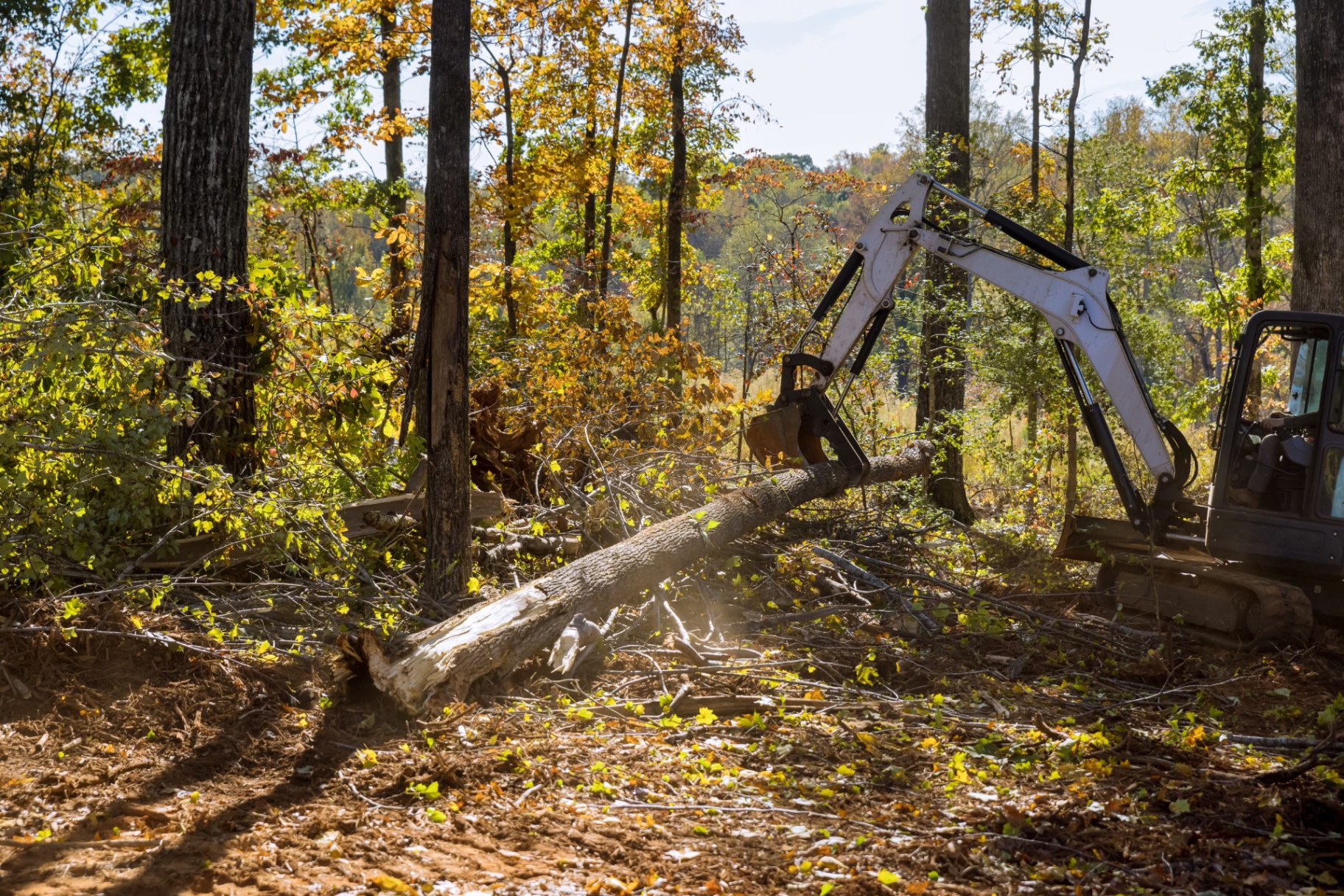
On long private access roads through wooded acreage, clearing is a separate cost from the driveway itself. A 15 to 20 foot wide cleared corridor gives room for the driveway plus shoulder and drainage, with enough setback to keep falling limbs off the wearing course.
Radius matters on any driveway a fire truck or delivery truck needs to use. A 30 foot inside radius on curves and turnouts every 400 feet on long access roads keeps trucks moving. Tight residential driveways with an under-25 foot radius will get chewed up on the outside edge every time a big truck comes through.
Typical Rural Driveway Timeline
A 500 foot straightforward rural driveway on cleared ground with good soils is usually a three to five day job. A 1,500 foot access road with clearing, culverts and drainage typically runs two to four weeks. Wet weather doubles both.
We plan driveway builds around the dry season when possible. Piedmont clay compacts properly at optimum moisture content, and a base built on wet subgrade is a base that will pump and rut the first time a loaded truck rolls across it.
How Rural Driveways Fail
The failures are consistent. Almost every rutted, washed-out rural driveway we get called to rebuild has one or more of these problems.
- Stone dumped on unstripped subgrade; base pumps within a season
- Single stone product used from bottom to surface; no structural section
- No crown or cross slope; water runs down the driveway itself
- Undersized or missing culverts at low points
- No compaction; owner relied on truck traffic to pack the stone
- No shoulder or ditch shaping; edges wash out first
Getting Priced for Your Driveway
A real rural driveway quote comes from walking the alignment, checking soils at the wet points, sizing culverts and pricing the stone by measured length and width. Anything faster is a guess, and the guess is almost always low.
Our grading team builds rural driveways and access roads across the NC Piedmont and Southern Virginia. If you have a build site down a long alignment or a driveway that keeps washing out, we will walk it and price the rebuild in components.
Frequently Asked Questions
How much does a rural driveway cost per foot in NC?
In 2026, a properly built 12 to 14 foot wide gravel driveway with base, stone and basic drainage runs $18 to $35 per linear foot. Short residential drives can price lower; long access roads with clearing and culverts push higher.
How thick should a gravel driveway be?
A durable rural driveway has 4 to 6 inches of compacted ABC or crush and run as a structural base, plus a 1 to 2 inch wearing course on top. Anything thinner will rut under repeat truck traffic.
Do I need a culvert for my driveway?
Any point where a ditch, swale or drainage feature crosses the driveway needs a culvert sized to the drainage area. Under-sizing a culvert is the fastest way to lose a crossing in a real rain.
What is the best stone for a rural driveway?
A layered section works best: ABC or crush and run as the structural base, topped with a smaller dense-graded wearing course. Single-product driveways using only washed stone or only crusher fines rarely hold up.
How long does it take to build a rural driveway?
A 500 foot driveway on cleared ground takes three to five days. A 1,500 foot access road with clearing, culverts and drainage typically runs two to four weeks, weather permitting.
Ready to talk through your project?
We walk every property in person before quoting. Get a straight answer from a crew that runs this work every week.
Keep Reading
Land Grading and Yard Leveling Cost in the NC Piedmont
Grading quotes swing wildly because the word means five different jobs. Here is what land grading and yard leveling actually cost, and how to compare bids line by line.
Read guide ExcavationStump Grinding and Stump Removal Cost in the NC Piedmont
Per stump, per hour or per acre? Here is how stump grinding and full root removal are priced in the NC Piedmont, and what makes one quote double another.
Read guide Land ManagementPasture Clearing and Reclamation Cost in North Carolina and Southern Virginia
Grown-up pasture comes back in stages, not one pass. Here is the full reclamation sequence and what each step costs, from first mulching pass to first grazing season.
Read guideGet a Free Insights follow-up (Grading and Drainage) Quote
Step 1 of 2: tell us how to reach you and what service you need. We'll follow up with honest guidance and a written quote.
Ready to reclaim your property?
Free, no-pressure quotes across the NC Piedmont Triad. Call today.