
Land Management · Insights
Storm Damage Cleanup on Large Properties in the NC Piedmont
Storm damage on a rural NC property is not just a tree removal problem. It is an access, drainage, safety and documentation problem, and the order you tackle it in decides whether cleanup takes a week or a season.
This guide walks through how we triage storm damage cleanup on large Piedmont properties, from the first hours after the storm through final regrade, and how to document everything so insurance actually pays.
First 24 Hours: Safety and Access
Before any cleanup, walk the property with a phone camera. Note every downed tree touching power lines, every leaning tree that has not fallen yet, and every washed-out section of driveway or crossing. Do not touch a tree hung on a power line. Call the utility first, always.
The immediate priority is restoring one safe path in and out. That usually means a single-lane clear-through on the main driveway, culverts checked for blockage, and any leaning tree threatening the house dropped by a crew with a bucket truck or crane before the next weather system arrives.
Document Everything Before Cleanup Starts
Homeowners and farm insurance policies vary widely on storm cleanup. Most cover tree removal only when a tree hits a covered structure. Damage to the land itself, driveways and out-of-service acreage often falls outside the policy.
Regardless, document. Wide shots and close-ups of every damaged area, every leaning tree, every washed-out crossing. Time-stamped photos, GPS coordinates when possible, and a written punchlist. The claim you can prove is the claim that gets paid.
Triage: What to Clear First, Second and Last
On a large storm-hit property, work outward from the house in bands.
- Band 1: Any tree on a structure, on a power line or blocking the driveway
- Band 2: Trees threatening structures or vehicles, and any washed-out drive or culvert
- Band 3: Woods roads, trails, fence lines and pasture fence damage
- Band 4: Back acreage, hunting lanes, food plots and long-term regrowth areas
Equipment and Methods for Large-Property Cleanup
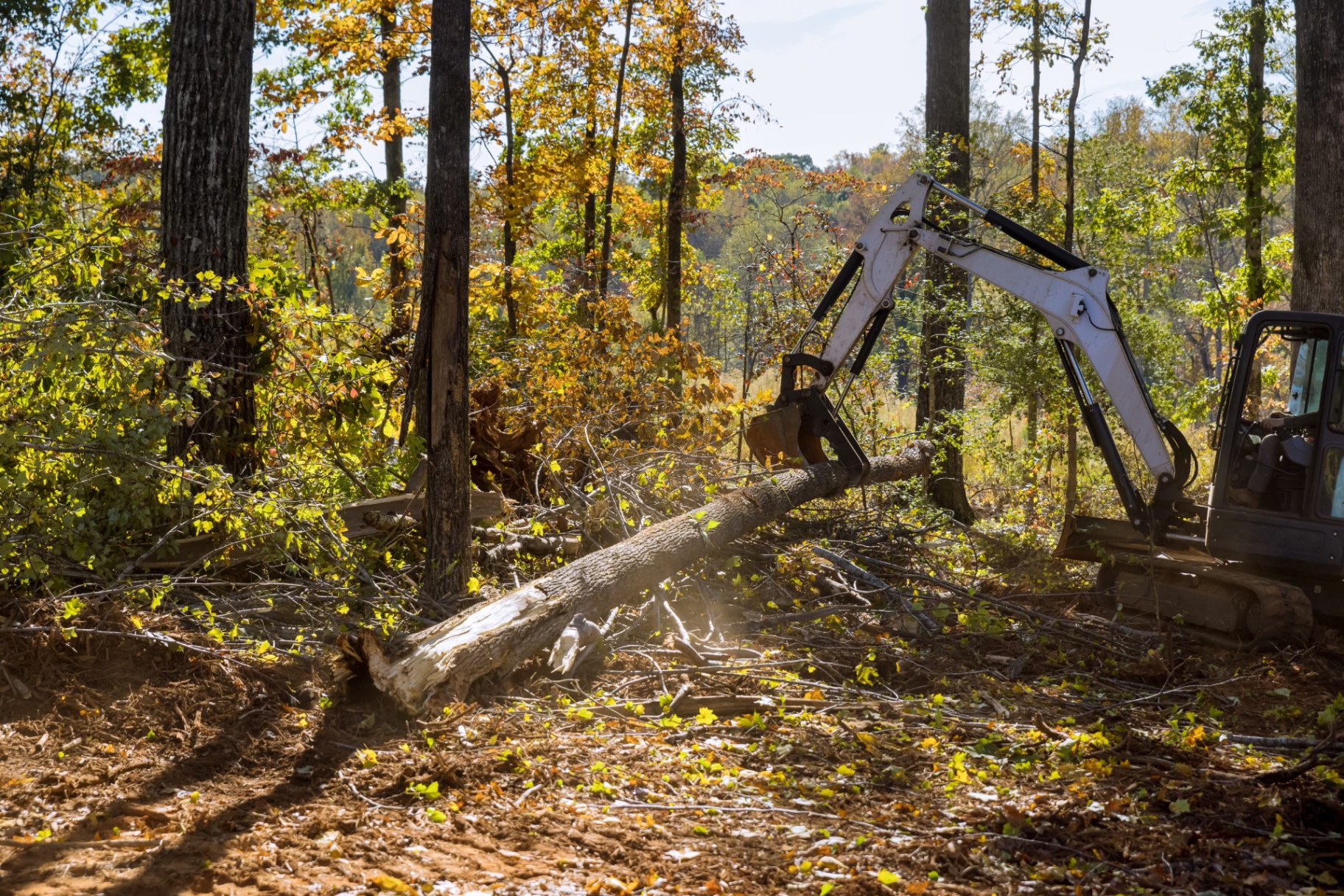
Storm cleanup on acreage is not a chainsaw-only job. A tracked excavator with grapple is the workhorse for lifting, sorting and stacking downed timber safely without groundcrew standing under leaning wood. A forestry mulcher handles the finer debris, briars and broken tops that a chainsaw crew would leave behind.
For long driveways and access roads, a skid steer with grapple bucket and a small dozer restore travel width fast. Culverts get cleaned or replaced. Ditches get reshaped so the next rain does not compound the damage.
Handling Storm Debris
Debris has three destinations on a large-property cleanup: salvage timber for milling or firewood, burn piles for the rest, and mulch left on site for anything a forestry mulcher can grind. Most rural properties do a mix of all three.
Burn permits are required in most NC counties during regular fire seasons and are often restricted after dry stretches. A legitimate contractor pulls the permit or coordinates with the local fire marshal. Piling and burning without a permit is a fast way to add a fine to an already expensive week.
What Storm Cleanup Actually Costs
Storm cleanup is priced by hour and equipment, not acre, because every property is unique. Typical crew rates on Piedmont acreage in 2026 run $250 to $500 per hour for an operator plus machine, and full days for a two-machine crew land in the $2,500 to $4,500 range.
Blowdowns concentrated in one area clear fast. Scattered damage across forty wooded acres takes longer because the crew spends time moving between trees. Written estimates should reflect that distinction rather than a flat per-acre number.
Restoring the Property After the Cleanup
Once the acute damage is out, the property still needs restoration: driveway regrade, culvert repair, ditch reshaping, pasture rework and often a mulching pass on any woods where broken tops and briars are now going to explode with sun.
Building that restoration phase into the cleanup contract avoids two mobilization fees and gets the land back to fully usable faster. Our team handles the whole sequence, from first-hour triage through final regrade and reseeding.
Frequently Asked Questions
How much does storm damage cleanup cost on a large property?
Storm cleanup is priced by hour and equipment, not acreage. Piedmont crew rates in 2026 typically run $250 to $500 per hour per operator plus machine, with two-machine crew days in the $2,500 to $4,500 range.
Does homeowners insurance cover storm cleanup?
Most policies cover tree removal only when a tree hits a covered structure. Damage to the land itself, driveways and out-of-service acreage is often outside the policy. Document everything with photos before cleanup starts and check with your carrier.
What should I do first after a storm?
Safety first. Never touch a tree on a power line, call the utility. Then walk the property with a camera, document damage, and clear one safe path in and out of the property before anything else.
Do I need a permit to burn storm debris?
Most NC counties require a burn permit during fire seasons and restrict burning after dry stretches. A legitimate cleanup contractor pulls the permit or coordinates with the local fire marshal.
How long does storm cleanup take on rural acreage?
Concentrated blowdowns clear in a few days. Scattered damage across forty wooded acres can take a week or more because the crew spends significant time moving between trees. A written estimate should reflect the pattern of damage, not just total acreage.
Ready to talk through your project?
We walk every property in person before quoting. Get a straight answer from a crew that runs this work every week.
Keep Reading
Land Grading and Yard Leveling Cost in the NC Piedmont
Grading quotes swing wildly because the word means five different jobs. Here is what land grading and yard leveling actually cost, and how to compare bids line by line.
Read guide ExcavationStump Grinding and Stump Removal Cost in the NC Piedmont
Per stump, per hour or per acre? Here is how stump grinding and full root removal are priced in the NC Piedmont, and what makes one quote double another.
Read guide Land ManagementPasture Clearing and Reclamation Cost in North Carolina and Southern Virginia
Grown-up pasture comes back in stages, not one pass. Here is the full reclamation sequence and what each step costs, from first mulching pass to first grazing season.
Read guideGet a Free Insights follow-up (Land Management) Quote
Step 1 of 2: tell us how to reach you and what service you need. We'll follow up with honest guidance and a written quote.
Ready to reclaim your property?
Free, no-pressure quotes across the NC Piedmont Triad. Call today.