Land Management · Insights
Forestry Mulching vs Bush Hogging: How to Pick the Right Cut for Your Property
Forestry mulching and bush hogging get lumped together every day in the quote inbox, and they should not be. Both cut brush. Both use tracked or wheeled machines. Both leave the debris on the ground. But the results, the cost and the machines are very different, and picking the wrong one wastes money on almost every job.
This guide is a practical, side-by-side comparison from crews that run both types of equipment every week across the NC Piedmont. Use it to pick the right service for your property, or to spot a contractor who is quoting one and delivering the other.
What Each Machine Actually Does
Bush hogging is rotary mowing at scale. A rear-mounted or pull-behind cutter with heavy swinging blades knocks down grass, weeds and light brush up to about an inch and a half thick. It is fast, cheap and best on open ground that already sees regular use.
Forestry mulching is grinding, not mowing. A tracked carrier runs a rotary drum with fixed steel teeth that shreds standing brush, saplings and small trees up to six inches thick in place. It leaves a mulch layer on the ground and can handle terrain that a bush hog simply cannot get through.
When Bush Hogging Is the Right Call
Bush hogging is the right tool when the ground is already mostly open and the goal is regular maintenance. Pastures that see cattle or horses, hay fields between cuttings, orchard aisles, food plots after harvest, and open field edges are all classic bush hog jobs.
It is the cheapest way to keep an acre under control, and on properties that get maintained on a schedule, it is the only thing you should be paying for.
- Established pasture that needs periodic knock-down
- Hay field cleanup between cuttings
- Food plot preparation on already-open ground
- Field edges and firebreaks that are already cleared
- Rough mowing along fence lines and ditch banks
When Forestry Mulching Is the Right Call
Forestry mulching is the right tool when the ground has gone past what a bush hog can handle. Once brush stems get thicker than an inch and a half, or once small trees start filling in, a bush hog will stall, throw belts or scalp the ground.
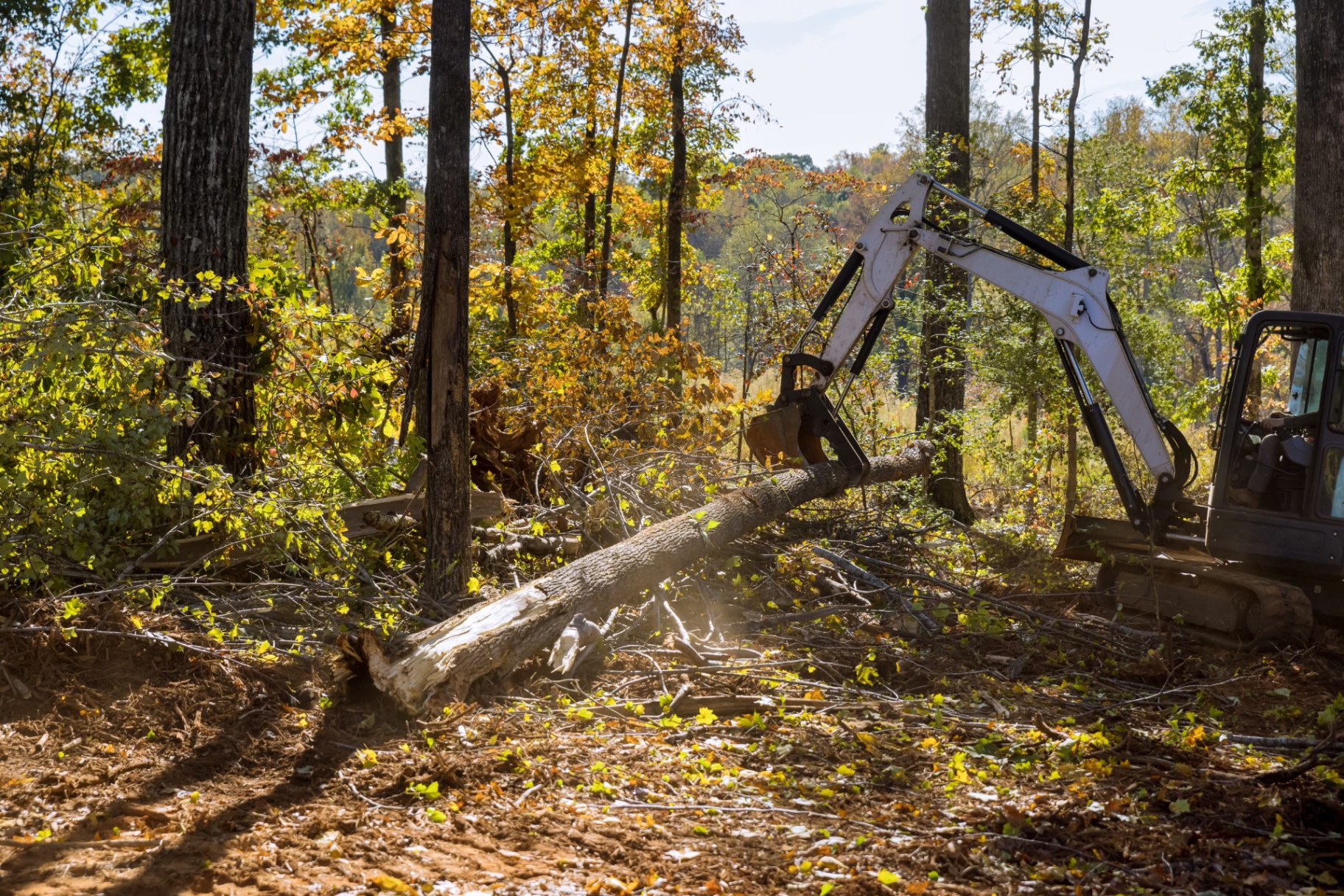
Mulching is also the right call anytime you need selective cutting, wooded reclamation, trail cutting or view corridors. It can pick its way between keep trees and grind everything else without stripping the site.
- Overgrown pasture that has not been maintained in five or more years
- Wooded acreage where you want to keep the mature canopy
- Trail networks through timber
- Reclaimed hunting land and food plot expansion into wooded edges
- Building envelopes on lightly wooded lots where you want to leave root systems in place
Cost Comparison in the Real World
Bush hogging is priced by acre or by hour and is by far the cheaper service. Typical Piedmont pricing runs $50 to $90 per acre for light annual maintenance and $150 to $400 per acre for heavier brush that a bush hog can still handle. Hourly rates land around $95 to $150 for tractor and operator on smaller jobs.
Forestry mulching is priced per acre against actual density. Light mulching runs $1,800 to $3,200 per acre and heavy mulching runs $3,500 to $5,500 per acre. It is a bigger number, but it is buying you work that a bush hog physically cannot do.
Which One Fits the Long Term Plan
The best framework is to think about the property in two phases. Phase one is bringing the ground back to a manageable state. Phase two is keeping it there.
Phase one is almost always a mulching job if the ground has been neglected. Phase two, once the ground is open and stable, becomes a bush hogging job on a schedule. Owners who try to skip phase one and start with bush hogging usually end up burning up equipment or hiring us to come back and mulch anyway.
Common Mistakes When Choosing
The most expensive mistakes come from mismatching the tool to the job. These are the ones we see every season.
- Hiring a bush hog for ground that clearly needs mulching, then paying for the same job twice
- Paying for mulching on ground that a bush hog would have handled at a third of the price
- Skipping the maintenance schedule after a mulching job and letting the property regrow within two seasons
- Assuming any tractor operator can mulch: forestry mulching is a specialty machine and a specialty operator
- Not asking about slope and moisture: a wet field will chew up either machine
A Quick Decision Framework
If the ground is already open and just needs a knockdown, hire a bush hog. If the brush is over your knees, has real stems in it, or has any trees, hire forestry mulching. If you are trying to keep a canopy, hire forestry mulching. If you are on a schedule and just want the field cut, hire a bush hog.
For a walkthrough of the specific work behind each service, see the brush hogging and forestry mulching pages, or reach out through the contact page and we will walk the property with you.
Frequently Asked Questions
Can a bush hog cut small trees?
Only lightly. Most bush hogs are rated to about an inch and a half in stem diameter. Pushing beyond that stalls the machine, bends blades and beats up the drivetrain. Anything thicker should be handled by forestry mulching.
Will forestry mulching kill the roots?
Not directly. Mulching cuts the stems flush and grinds the standing material, but root systems stay in the ground. On aggressive species like sweetgum, tree of heaven and privet, expect regrowth that will need a follow-up cut or a targeted herbicide plan.
How often should I bush hog a pasture in NC?
Once or twice a year keeps most Piedmont pastures under control if they are already established. Neglected ground that has grown up into brush needs mulching first, then can drop back to a bush hog schedule.
Is one better for wildlife?
Forestry mulching is usually the better wildlife tool because it leaves cover, mast trees and edge habitat while opening browse. Bush hogging is best for maintaining food plots and open feed strips once those areas already exist.
Can I do both on the same property?
Yes, and most working properties should. Mulch to reclaim, then bush hog on a schedule to maintain. That combination is almost always cheaper over five years than repeated heavy clearing.
Ready to talk through your project?
We walk every property in person before quoting. Get a straight answer from a crew that runs this work every week.
Keep Reading
Land Grading and Yard Leveling Cost in the NC Piedmont
Grading quotes swing wildly because the word means five different jobs. Here is what land grading and yard leveling actually cost, and how to compare bids line by line.
Read guide ExcavationStump Grinding and Stump Removal Cost in the NC Piedmont
Per stump, per hour or per acre? Here is how stump grinding and full root removal are priced in the NC Piedmont, and what makes one quote double another.
Read guide Land ManagementPasture Clearing and Reclamation Cost in North Carolina and Southern Virginia
Grown-up pasture comes back in stages, not one pass. Here is the full reclamation sequence and what each step costs, from first mulching pass to first grazing season.
Read guideGet a Free Insights follow-up (Land Management) Quote
Step 1 of 2: tell us how to reach you and what service you need. We'll follow up with honest guidance and a written quote.
Ready to reclaim your property?
Free, no-pressure quotes across the NC Piedmont Triad. Call today.